
Historical sketch
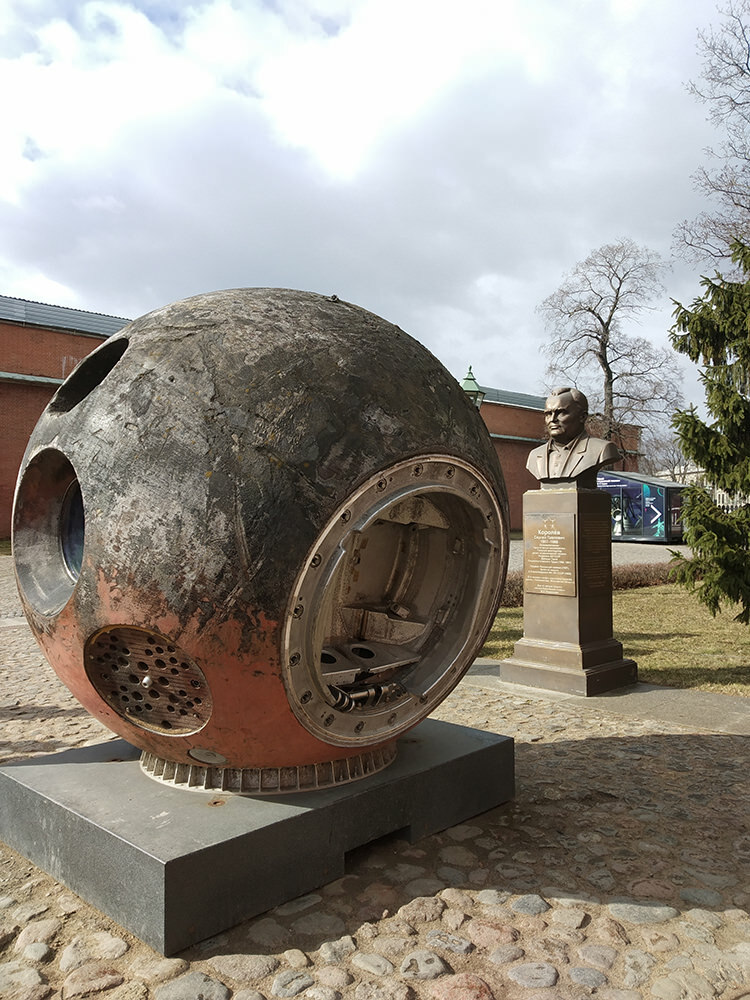 The museum's exhibition is dedicated to the history of Russian cosmonautics and rocketry and the role played by St. Petersburg and Leningrad scientists, engineers, and designers in the development of this area of Russian science and technology. The museum is housed in the Ioannovsky Ravelin, which housed the Second Department of the Gas Dynamics Laboratory (GDL) in 1932-1933 - the first Russian experimental design organization for rocket engine development.
Test rigs for electric and liquid rocket engines were also located here. The GDL department at the Peter and Paul Fortress was headed by Valentin Petrovich Glushko. The museum displays reconstructions of the designers' offices (including V.P. Glushko's office) and workshops, as well as documents and photographs related to the GDL's activities.
The exhibition presents unique developments by the laboratory's designers: smokeless powder rockets (later used in the BM-13 mortar launcher, the so-called "Katyusha"), liquid-propellant rocket engines, and their direct descendants—the sustainer engines of space rockets. The museum's halls display models of the first artificial satellite (launched in the USSR on October 4, 1957) and the Vostok spacecraft (which carried the world's first cosmonaut, Yuri Gagarin, into space on April 12, 1961, and the first woman cosmonaut, Valentina Tereshkova, into space on June 16–19, 1963). One of the museum's most fascinating exhibits is the descent module of the Soyuz-16 spacecraft, which flew into space and returned to Earth in December 1974.
The exhibition features a 1:50 scale model of the International Space Station (ISS)—a manned orbital station used as a multipurpose space research complex. The ISS's deployment in low-Earth orbit began with the launch of the Zarya functional cargo module on November 20, 1998. Construction of the ISS continues in orbit, with the successive addition of modules. On November 2, 2000, the crew of the first main expedition arrived at the station. Today, the ISS is a joint project involving the space agencies ROSCOSMOS, NASA (USA), JAXA (Japan), CSA (Canada), and ESA (European countries). In May 2017, the museum's exhibition was expanded with 1:1 scale models of the dining area and hygiene room in the Zvezda service module of the ISS's Russian segment. In front of the entrance to the museum in the Ioannovsky Ravelin, the descent module of the Kometa topographic satellite (the flight took place in 1991) and the descent module of the Soyuz MS-02 spacecraft (the flight took place in 2016-2017) that have been in space are installed.